
A guide, not a schedule.
Leave room to linger
Total outing time depends on the stops you choose. Original time and distance estimates are being checked.
Check your own route
Stairs, surfaces, and step-free entrances have not had a complete field audit. Check access with each venue.
Choose what interests you
Read from anywhere, or follow selected chapters in person. Entry tickets and transport are separate.
A story at every stop.
Introduction
Welcome to Voyage Owl’s walking tour of Frankfurt, one of Germany's most dynamic and historically rich cities. Often known as the financial capital of Germany, Frankfurt is home to the European Central Bank and a host of modern skyscrapers that define its skyline. However, beyond its glass towers, Frankfurt offers a deep and fascinating history that stretches back over 1,000 years. From its origins as a Roman settlement to its status as the birthplace of Johann Wolfgang von Goethe, one of Germany's greatest writers, Frankfurt blends tradition and modernity like few other cities in Europe.
Frankfurt has long been a center of commerce, politics, and culture. It was here that the German kings and emperors of the Holy Roman Empire were crowned, and it served as a key trading hub thanks to its location along the Main River. Over the centuries, the city has been shaped by its role in European history, from the Holy Roman Empire to the Napoleonic Wars, and from the rise of the Frankfurt Stock Exchange to its current status as a major European financial center. Today, Frankfurt is a vibrant, cosmopolitan city known for its cultural institutions, historic landmarks, and modern attractions.
This walking tour will take you through the heart of Frankfurt, from its medieval Old Town to its modern skyscrapers, exploring the city’s most significant historical landmarks and cultural treasures. Along the way, we’ll delve into Frankfurt’s fascinating past and discover the places where history, art, and commerce intersect to create the Frankfurt we know today.
Römerberg
Our tour begins at Römerberg, the historic heart of Frankfurt and one of the city’s most iconic squares. The Römerberg has been the center of Frankfurt’s public and civic life for centuries, serving as the site of imperial coronations, trade fairs, and public festivals. Surrounded by beautifully reconstructed medieval buildings, the square offers a glimpse into Frankfurt’s rich past as one of the most important cities in the Holy Roman Empire.
The Römer, the town hall that gives the square its name, has stood here since the 15th century and has been the seat of Frankfurt’s city government for more than 600 years. The building is one of the most recognizable landmarks in Frankfurt, with its distinctive stepped gables and Gothic architecture. The Römer was the site where the emperors of the Holy Roman Empire were elected and later crowned in the nearby Frankfurt Cathedral (Kaiserdom). The building’s Kaisersaal (Emperor’s Hall) is filled with portraits of the emperors who were crowned here, making it a significant site in the history of the Holy Roman Empire.
The Fountain of Justice (Gerechtigkeitsbrunnen), which stands in the center of the square, is another important feature of the Römerberg. The fountain, with its statue of Lady Justice holding scales, symbolizes Frankfurt’s role as a city of law and commerce. Surrounding the square, you’ll find reconstructed half-timbered houses that date back to the Middle Ages. These houses were rebuilt after being destroyed during World War II, but they capture the essence of medieval Frankfurt.
The Römerberg has been the civic and political heart of Frankfurt for centuries. It was here that emperors were crowned, and it has played host to countless festivals, markets, and public gatherings. The square’s medieval architecture and historical significance make it one of the most important landmarks in the city.
Take your time to explore the Römerberg, especially the Römer building and its impressive Kaisersaal. The square is a great place to start your journey through Frankfurt’s history, and if you’re visiting during the holiday season, you’ll find the Frankfurt Christmas Market in full swing here.
Frankfurt Cathedral (Kaiserdom St. Bartholomäus)
Just a short walk from the Römerberg, we arrive at the Frankfurt Cathedral, or Kaiserdom St. Bartholomäus, a Gothic masterpiece and one of the most important religious buildings in the city. The Kaiserdom is not a cathedral in the traditional sense, as it has never been the seat of a bishop, but it holds great significance as the site where emperors of the Holy Roman Empire were crowned between 1356 and 1792.
The cathedral’s history stretches back to the 7th century, when a small Merovingian chapel stood on this site. Over the centuries, the church was expanded and rebuilt, particularly after a devastating fire in 1867, when it was largely reconstructed in the Neo-Gothic style. Despite suffering severe damage during World War II, the cathedral was painstakingly restored, and it stands today as a symbol of Frankfurt’s resilience and historical importance.
The Kaiserdom is notable for its towering 95-meter spire, which dominates the city’s skyline and offers stunning views of the surrounding area if you’re willing to climb the 328 steps to the top. Inside, the cathedral’s high vaulted ceilings, stained glass windows, and religious artworks create a majestic and solemn atmosphere. One of the highlights is the Marienkapelle (Chapel of Mary), where the imperial coronation ceremonies took place. The chapel’s intricate carvings and altarpiece reflect the grandeur of these important historical events.
The Frankfurt Cathedral played a central role in the history of the Holy Roman Empire, as it was here that emperors were crowned for centuries. The cathedral’s architecture and art reflect its importance as a place of religious and political power.
Be sure to climb the cathedral’s spire for a panoramic view of Frankfurt’s blend of medieval and modern architecture. Inside, take time to explore the Marienkapelle and the cathedral’s many side chapels, which offer a glimpse into the city’s religious and imperial past.
Paulskirche (St. Paul’s Church)
A short distance from the Kaiserdom, we arrive at Paulskirche, or St. Paul’s Church, one of the most important symbols of democracy in Germany. While it may not be as visually striking as other churches in Frankfurt, its historical significance cannot be overstated. Paulskirche was the site of the first freely elected German National Assembly in 1848, making it the birthplace of German democracy.
Built in the 18th century as a Protestant church, Paulskirche played a central role in German politics during the turbulent years of the 1848 Revolutions, when liberal forces across Europe demanded more rights and freedoms. The National Assembly, which convened here, sought to create a unified and democratic Germany, though the assembly ultimately failed in its goals. Despite this, Paulskirche remains a powerful symbol of the struggle for democracy and freedom in Germany.
After being heavily damaged during World War II, Paulskirche was one of the first buildings in Frankfurt to be rebuilt, reflecting its importance to the nation’s history. Today, it serves as a memorial to German democracy and is used for exhibitions and public events.
Paulskirche is the birthplace of German democracy and a symbol of the liberal movements that shaped the modern German state. Its role as the site of the 1848 National Assembly marks it as one of the most significant political landmarks in Frankfurt.
Take time to visit the interior of Paulskirche, where you’ll find exhibits on the history of the National Assembly and the development of democracy in Germany. The church’s circular design and simple interior reflect its role as a gathering place for political debate.
Goethe House and Museum
Next, we make our way to the Goethe House, the birthplace of Johann Wolfgang von Goethe, one of Germany’s greatest literary figures. Goethe, born in 1749, spent his formative years in this house, and it was here that he wrote many of his early works, including The Sorrows of Young Werther, a novel that had a profound impact on European literature. The house has been meticulously restored to reflect the conditions of the 18th century, offering visitors a glimpse into the environment that shaped Goethe’s early life and literary career.
The Goethe House is filled with period furniture, family portraits, and original manuscripts that belonged to the Goethe family. As you explore the rooms, you’ll gain insight into the daily life of an upper-middle-class family in Frankfurt during the 18th century. Highlights include Goethe’s study, where he wrote some of his most famous works, and the music room, which reflects the family’s love of culture and the arts.
Attached to the Goethe House is the Goethe Museum, which features an impressive collection of artworks and memorabilia related to Goethe’s life and legacy. The museum’s collection spans several centuries and includes paintings, sculptures, and drawings that depict scenes from Goethe’s works and life. For those interested in literature, history, or art, the Goethe House and Museum offer a fascinating look into the life of one of Germany’s most important cultural figures.
The Goethe House is the birthplace of one of Germany’s greatest writers and intellectuals. It offers a unique insight into the life and times of Johann Wolfgang von Goethe and his lasting impact on European literature and culture.
After exploring the Goethe House, be sure to visit the attached Goethe Museum, where you can see artworks inspired by Goethe’s writings. If you’re a literature lover, this is an essential stop to understand the origins of one of Germany’s literary giants.
Eiserner Steg (Iron Footbridge)
From the Goethe House, we head towards the Main River, where we cross the iconic Eiserner Steg, or Iron Footbridge, which has connected the two sides of the city since 1869. The Eiserner Steg is one of Frankfurt’s most popular pedestrian bridges, offering stunning views of the city’s skyline, the Main River, and the surrounding area.
The Iron Footbridge was built during the height of the Industrial Revolution and is a symbol of Frankfurt’s growth as a modern city. Originally constructed to facilitate trade and transportation across the Main River, the bridge has become a beloved landmark for both locals and tourists. Today, the bridge is adorned with love locks, placed there by couples as a symbol of their affection, adding a modern tradition to this historic structure.
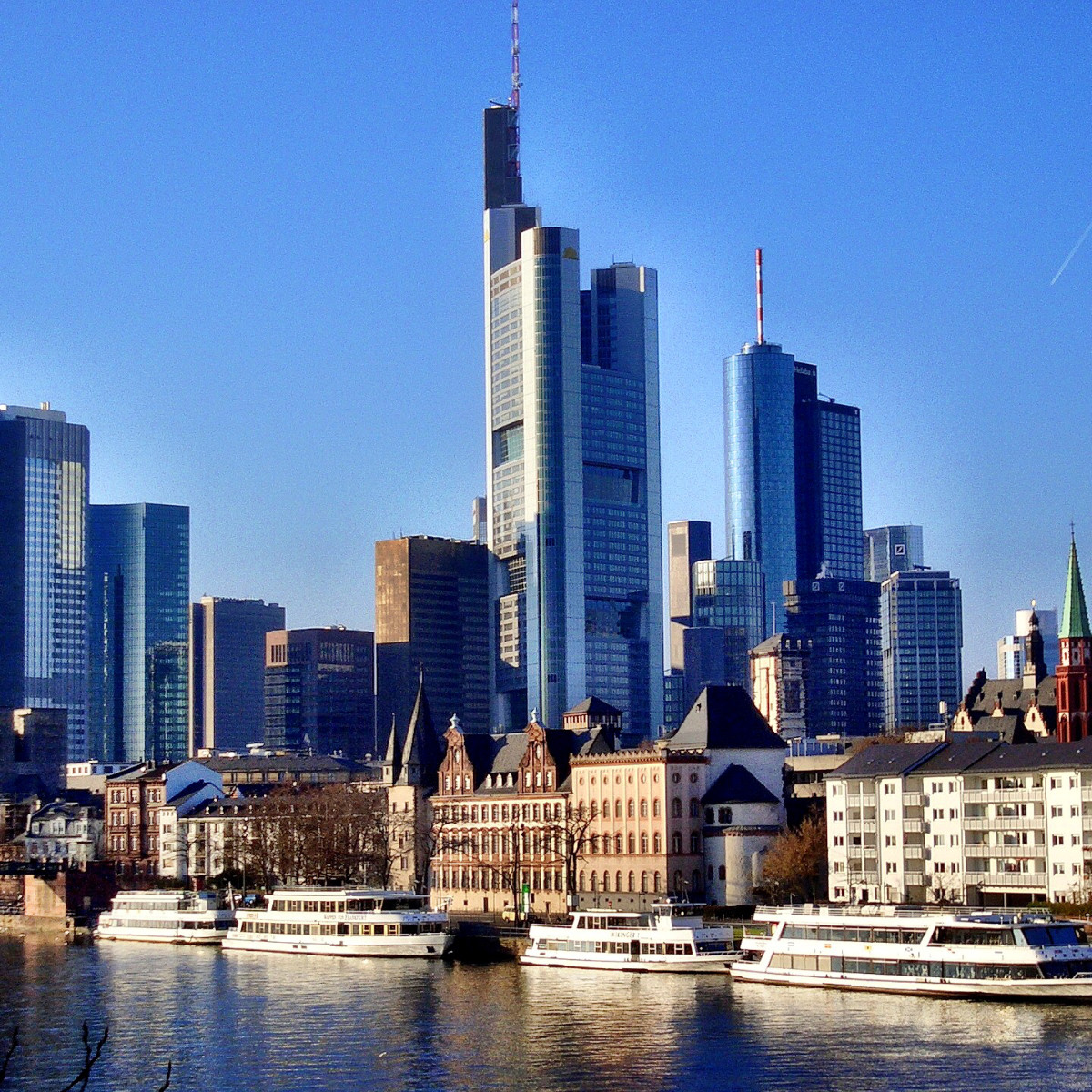
As you cross the bridge, you’ll have a clear view of the contrast between Frankfurt’s Old Town, with its medieval spires and Gothic architecture, and the modern skyline, dominated by the glass and steel towers of the financial district. This juxtaposition highlights Frankfurt’s unique blend of history and modernity.
The Eiserner Steg reflects Frankfurt’s growth during the Industrial Revolution and its importance as a center of trade and commerce. The bridge has connected the two sides of the city for over a century and offers a symbolic link between Frankfurt’s past and present.
Take your time crossing the bridge and enjoy the views of Frankfurt’s skyline. If you’re looking for a great photo opportunity, this is the perfect spot, especially at sunset when the light reflects off the glass towers of the financial district.
Städel Museum
On the other side of the Main River, we arrive at the Städel Museum, one of the most important art museums in Germany and a must-visit for art lovers. Founded in 1815 by the banker and art collector Johann Friedrich Städel, the museum houses an impressive collection of over 700 years of European art, spanning from the Middle Ages to contemporary works.
The Städel Museum features masterpieces by artists such as Rembrandt, Vermeer, Monet, Picasso, and Francis Bacon, making it one of the most comprehensive collections in Europe. The museum’s galleries are organized chronologically, allowing visitors to trace the development of European art through the centuries. Highlights include the Old Masters collection, which features works from the Renaissance and Baroque periods, as well as the museum’s impressive collection of modern and contemporary art.
In addition to its permanent collection, the Städel Museum hosts rotating exhibitions that showcase specific artists, movements, or periods, offering visitors new perspectives on European art. The museum’s modern wing, a striking glass structure added in 2012, provides a beautiful contrast to the historic building and is home to the museum’s contemporary art collection.
The Städel Museum is one of Germany’s most prestigious art institutions, with a collection that reflects the richness and diversity of European art. It plays a key role in Frankfurt’s cultural life and offers visitors the opportunity to explore centuries of artistic achievement.
Be sure to check the museum’s schedule for temporary exhibitions, as the Städel Museum often hosts world-class shows. The museum’s café is also a great spot to relax and enjoy a coffee while surrounded by beautiful art.
Frankfurt Stock Exchange (Frankfurter Wertpapierbörse)
Next, we head back across the river to visit the Frankfurt Stock Exchange, one of the oldest and most important stock exchanges in the world. Founded in 1585 as a place for merchants to trade currencies, the Frankfurt Stock Exchange has grown into a global financial powerhouse, and today, it is home to the DAX (Germany’s main stock market index).
The stock exchange is housed in a grand Neoclassical building on Börsenplatz, which reflects the importance of Frankfurt as a center of commerce and finance. The Frankfurt Stock Exchange is more than just a place for financial transactions—it’s a symbol of the city’s role in global trade and economics. The Bull and Bear statues outside the building represent the fluctuations of the stock market, with the bull symbolizing rising markets and the bear representing falling markets.
While the interior of the Frankfurt Stock Exchange is not open to the general public, you can visit the exterior and take in the grandeur of the building. The stock exchange remains one of Frankfurt’s most iconic symbols, representing the city’s position as a major global financial hub.
The Frankfurt Stock Exchange is one of the oldest and most important financial institutions in Europe. Its role in global finance reflects Frankfurt’s historical importance as a center of commerce and its status as Germany’s financial capital.
After visiting the Frankfurt Stock Exchange, take a stroll around the nearby Börsenplatz, where you’ll find modern sculptures and cafés. If you’re interested in the history of finance, visit the nearby Money Museum for a deeper dive into the world of banking and currency.
Palmengarten (Botanical Gardens)
Our final stop takes us to the Palmengarten, a stunning botanical garden that offers a peaceful escape from the hustle and bustle of the city. Founded in 1871, the Palmengarten is one of the largest botanical gardens in Germany and features a wide variety of plants from around the world, from tropical rainforests to arid deserts.
The Palmengarten was originally funded by donations from Frankfurt’s citizens and quickly became a popular destination for both locals and tourists. The garden’s many greenhouses allow visitors to explore different climates and ecosystems, with plants from the Amazon, Southeast Asia, and Africa on display. In addition to its botanical collections, the Palmengarten hosts concerts, festivals, and exhibitions throughout the year, making it a vibrant cultural space.
One of the highlights of the Palmengarten is the Tropicarium, a series of greenhouses that simulate tropical and subtropical climates. The Subantarctic House offers a glimpse into the world of plants that thrive in cooler, more temperate regions, while the Cactus Garden showcases desert flora from around the world.
The Palmengarten reflects Frankfurt’s history as a city of culture and learning. Its botanical collections represent the city’s connection to the natural world and its role as a center of scientific research and education.
The Palmengarten is a great place to relax and unwind after a day of exploring Frankfurt. Be sure to visit the various greenhouses and take a leisurely stroll through the gardens. If you’re visiting during the summer, check the schedule for outdoor concerts and events.
Conclusion
Our walking tour of Frankfurt has taken you through centuries of history, from the medieval heart of the city at Römerberg to the modern financial district and beyond. Along the way, we’ve explored Frankfurt’s most iconic landmarks, including the Frankfurt Cathedral, Paulskirche, the Goethe House, and the Städel Museum, discovering the layers of history that make Frankfurt one of Germany’s most fascinating cities.
Frankfurt is a city where the past meets the present, where medieval churches stand alongside gleaming skyscrapers, and where history, culture, and commerce come together to create a vibrant and dynamic urban landscape. Whether you’re drawn to its historical significance, its cultural institutions, or its role as a global financial hub, Frankfurt offers something for everyone.
We hope this walking tour has given you a deeper appreciation for Frankfurt’s beauty, history, and cultural significance. Gute Reise! Enjoy the rest of your time in this remarkable city on the banks of the Main River!
To listen to more amazing audio tours of cities around the world check out our other guides at voyageowl.com