Your Braga month
Milder exploring. Keep a rain plan.
20°Caverage high
141mmmonthly rain
11hdaylight on 2026-10-15
Churches, gardens and layers of northern Portugal.
Discover the historical and religious heart of Braga, one of Portugal’s oldest cities, on this captivating walking tour. Start your journey at the Sé de Braga,…
8 stops · Self-guidedLink the cathedral, Arco da Porta Nova and Santa Barbara Garden.
Braga · Route guideGet to know The cathedral streets, Praça da República, Bom Jesus do Monte and choose a base for your visit.
Braga · Neighborhood guidePorto Airport lists getBUS connections to Braga. Compare a direct coach with rail via Porto for your actual arrival time.
Braga · Arrival guideFind family activities, a printable field guide and ideas for a shared adventure.
Braga · Family guideTake a listening break with the city’s audio story and full transcript.
Audio & transcriptLink the cathedral, Arco da Porta Nova and Santa Barbara Garden.
Our tour begins at the heart of Braga’s religious and historical identity: the Sé de Braga, or Braga Cathedral, one of the oldest and most important…
Read this chapter 02A story worth stopping forLeaving the Sé de Braga, we head to one of the city’s most iconic landmarks, the Arco da Porta Nova, a grand triumphal arch that serves as one of the main…
Read this chapter 03A story worth stopping forAfter passing through the Arco da Porta Nova, we arrive at the bustling Rua do Souto, one of the main pedestrian streets in Braga’s historic center. Lined…
Read this chapterMilder exploring. Keep a rain plan.
Porto Airport lists getBUS connections to Braga. Compare a direct coach with rail via Porto for your actual arrival time.
Explore arrival options Find a base for your plansBom Jesus and Sameiro are outside the compact center; do not treat them as the next short stop.
Compare areasA free field guide for looking closely, drawing what you notice and making up a few stories along the way.
Explore Braga with kidsDraw the outline of the cathedral entrance.
Imagine a welcome message for the city arch.
Find two different leaf shapes in the garden.
Take a seat, or take a walk. Discover Braga one story at a time.
Welcome to Voyage Owl’s tour of **Braga**, one of Portugal's oldest and most historically significant cities, often referred to as the "Rome of Portugal" due to its rich religious heritage and numerous churches. Nestled in the scenic **Minho** region of northern Portugal, Braga is a city that combines deep-rooted traditions with vibrant modern life. As the seat of Portugal’s **Archbishopric**, Braga has long been a center of Catholicism, not just in Portugal but throughout the Iberian Peninsula. Its history stretches back over 2,000 years, from its founding as the Roman city of **Bracara Augusta** to its role as a medieval center of learning and religious authority.
Braga is one of the country’s oldest cities, with a history dating back to **16 BC** when it was founded by the **Romans**. As **Bracara Augusta**, the city was a key administrative and cultural hub in the Roman province of **Gallaecia**. During the early medieval period, Braga rose to prominence as the religious capital of the newly Christianized kingdom, becoming the seat of the **Archbishop of Braga**, the highest ecclesiastical authority in Portugal. The city’s importance continued into the **Middle Ages** and the **Renaissance**, where it became a center of art, culture, and religious education.
Today, Braga remains a city where history, religion, and modernity converge. Its ancient streets are lined with magnificent **Baroque churches**, **Roman ruins**, and grand squares, all of which are reminders of its illustrious past. Yet, Braga is also a lively and youthful city, thanks in part to its large student population from the **University of Minho**, one of the top universities in Portugal. This unique blend of ancient tradition and youthful energy makes Braga an exciting and dynamic city to explore.
This walking tour will take you through Braga’s most iconic landmarks, uncovering the city’s fascinating history, religious significance, and cultural treasures. From ancient Roman ruins to splendid Baroque churches, and from tranquil gardens to bustling squares, this tour will showcase the best that Braga has to offer.
---
### 1. **Sé de Braga (Braga Cathedral)**
Our tour begins at the heart of Braga’s religious and historical identity: the **Sé de Braga**, or **Braga Cathedral**, one of the oldest and most important religious buildings in Portugal. Built in the **12th century**, the **Sé de Braga** predates Portugal’s founding as a kingdom and is a magnificent example of Romanesque, Gothic, and Baroque architectural styles, reflecting the city’s long history and religious importance.
The cathedral was commissioned by **Henry of Burgundy** and his wife, **Teresa of León**, the parents of **Afonso Henriques**, the first King of Portugal. It was designed to be the spiritual heart of the newly Christianized region, and over the centuries, it has been expanded and renovated to reflect changing architectural tastes and religious needs. The cathedral is not only a place of worship but also a symbol of Braga’s status as the ecclesiastical capital of Portugal.
One of the most striking features of the **Sé de Braga** is its façade, which combines elements of the **Romanesque** and **Gothic** styles, with two imposing towers and a richly decorated portal. The interior is equally impressive, with grand **Gothic vaults**, **Baroque altars**, and intricate wood carvings. The cathedral’s **high altar** is a stunning work of Baroque art, with its gilded wood and detailed sculptures.
Within the cathedral complex, you’ll also find the **Chapel of the Kings (Capela dos Reis)**, where the tombs of **Henry of Burgundy** and **Teresa of León** are located. This chapel is a key site for understanding the early history of the Portuguese monarchy. Another highlight is the **Treasury Museum**, which houses a remarkable collection of religious art and artifacts, including gold and silver relics, illuminated manuscripts, and ancient vestments.
The **Sé de Braga** is a symbol of the city’s religious and historical importance. It has been the seat of the **Archbishop of Braga** for over 900 years, making it a key center of Catholicism in Portugal. The cathedral’s architecture reflects the city’s long and complex history, from its medieval origins to its Baroque splendor.
Be sure to explore the **Treasury Museum**, which offers a fascinating look at Braga’s religious history. The **Chapel of the Kings** is also a must-see for anyone interested in Portuguese royal history. If you visit during a religious festival, such as **Semana Santa (Holy Week)**, the cathedral is a center of vibrant celebrations and processions.
---
### 2. **Arco da Porta Nova (Arch of the New Gate)**
Leaving the **Sé de Braga**, we head to one of the city’s most iconic landmarks, the **Arco da Porta Nova**, a grand triumphal arch that serves as one of the main entrances to the **Old Town**. Built in **1772** during the reign of **King Joseph I**, the **Arco da Porta Nova** is a striking example of **Baroque** architecture and is one of the most photographed sites in Braga. The arch was designed by **André Soares**, one of Portugal’s most famous Baroque architects, and it features intricate stone carvings and classical columns.
The **Arco da Porta Nova** replaced an earlier medieval gate and was built to celebrate the city’s prosperity and status as a religious and cultural center. The arch leads into the historic heart of Braga, and its grand design reflects the city’s importance as a gateway to the **Minho** region.
The **Arco da Porta Nova** is also steeped in tradition: local legend says that passing through the arch without looking back will ensure that you return to Braga in the future. Today, the arch remains a central point in the city’s bustling streets, where locals and visitors alike pass through on their way to explore Braga’s historic center.
The **Arco da Porta Nova** symbolizes Braga’s importance as a religious and cultural hub in the **18th century**. Its design reflects the city’s Baroque heritage, and it serves as a reminder of Braga’s historical role as a gateway to northern Portugal.
Be sure to stop for a photo at the arch, which is especially beautiful when illuminated at night. As you pass through, take a moment to appreciate the bustling energy of Braga’s **Old Town**, which lies just beyond.
---
### 3. **Rua do Souto and Praça da República**
After passing through the **Arco da Porta Nova**, we arrive at the bustling **Rua do Souto**, one of the main pedestrian streets in Braga’s historic center. Lined with charming cafés, shops, and historic buildings, **Rua do Souto** is the perfect place to experience the vibrant atmosphere of the city. The street is often filled with locals and students from the **University of Minho**, creating a lively, youthful energy that contrasts with the ancient surroundings.
As we walk down **Rua do Souto**, we arrive at the **Praça da República**, or **Republic Square**, one of the largest and most important public spaces in Braga. Known locally as **Arcada**, the square is dominated by a grand arcade that houses several cafés and restaurants, where you can sit and enjoy a coffee while watching the world go by. The square is a popular gathering place for locals, especially in the evenings when the cafés are full of people socializing and enjoying Braga’s famous **pastéis de nata** (Portuguese custard tarts).
At the center of the square is a beautiful fountain, and the **Igreja da Lapa**, a small but elegant Baroque church, adds to the architectural charm of the area. The **Praça da República** is a perfect spot to pause and take in the rhythm of daily life in Braga, as well as to appreciate the blend of old and new that defines the city.
**Rua do Souto** and the **Praça da República** reflect the blend of Braga’s historic charm and modern vibrancy. The square has long been a central meeting point for locals and is a symbol of the city’s dynamic social life.
Stop at one of the outdoor cafés in the **Praça da República** to try a **galão** (Portuguese coffee with milk) and a **pastel de nata**. The square is especially lively in the evenings, making it a great place to experience Braga’s social scene.
---
### 4. **Museu dos Biscainhos (Biscainhos Museum)**
Our next stop takes us to the **Museu dos Biscainhos**, a stunning **Baroque palace** that offers a glimpse into the aristocratic life of **18th-century** Braga. Built in the **17th century**, the **Biscainhos Palace** was once the home of a wealthy noble family and is now a museum that showcases the elegant lifestyle of Braga’s upper class during the **Baroque period**.
The palace is a fine example of **Baroque architecture**, with its grand façade, intricate stonework, and lush gardens. Inside, the rooms are furnished with period pieces, including tapestries, porcelain, and antique furniture. The **ballroom**, with its gilded mirrors and chandeliers, is particularly impressive and offers a sense of the opulence and grandeur of the time. The museum also features a collection of **Azulejos** (Portuguese ceramic tiles) that depict scenes from mythology and everyday life.
The **gardens** of the **Museu dos Biscainhos** are one of the highlights of the visit. Designed in the **French formal style**, the gardens are filled with manicured hedges, fountains, and statues, offering a peaceful retreat from the city. The gardens are a perfect spot to relax
and reflect on the history of Braga’s aristocracy.
The **Museu dos Biscainhos** offers insight into the aristocratic life of Braga during the **18th century**. The palace’s architecture and interior design reflect the city’s Baroque heritage and the wealth of its noble families.
Take your time exploring the gardens, which are a beautiful and tranquil escape. The museum often hosts temporary exhibitions, so check to see if any are taking place during your visit.
---
### 5. **Bom Jesus do Monte Sanctuary**
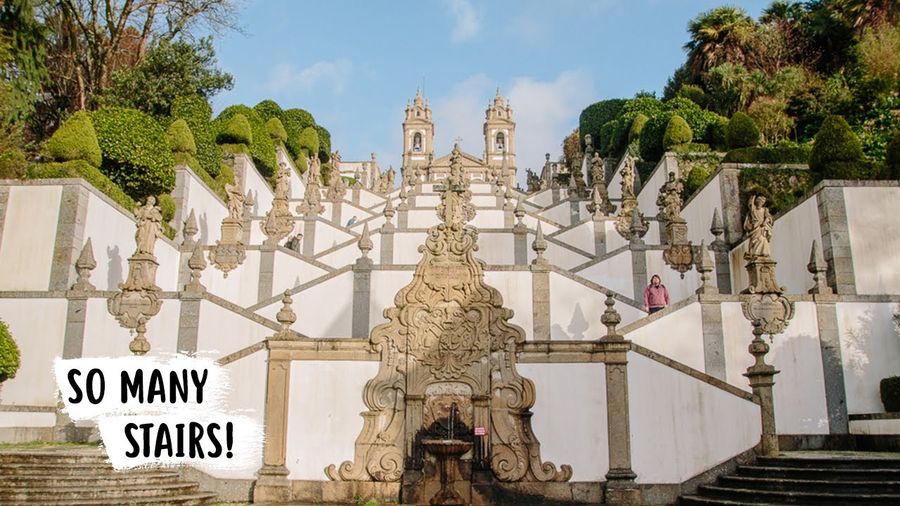
Next, we make our way to one of Braga’s most famous and breathtaking landmarks: the **Sanctuary of Bom Jesus do Monte**, a pilgrimage site located just outside the city. The **Bom Jesus do Monte** is known for its stunning **Baroque stairway**, which climbs 381 feet (116 meters) up a hillside and leads to the church at the summit. The sanctuary is dedicated to the **Passion of Christ** and has been a popular pilgrimage site since the **14th century**.
The **staircase** is one of the most remarkable features of the sanctuary. Divided into three sections—the **Via Sacra** (Sacred Way), the **Stairway of the Five Senses**, and the **Stairway of the Three Virtues**—the stairway represents a spiritual journey, with chapels at each level depicting scenes from the **Passion of Christ**. The **Stairway of the Five Senses** is particularly notable, as it features symbolic fountains representing sight, smell, hearing, taste, and touch.
At the top of the hill is the **Bom Jesus Church**, a beautiful **Neoclassical building** completed in **1811**. From the church, visitors are rewarded with panoramic views of Braga and the surrounding countryside. The sanctuary also includes beautiful gardens and fountains, making it a peaceful and reflective place to visit.
For those who prefer not to climb the staircase, a **funicular** railway, built in **1882**, offers an alternative way to reach the top. The funicular is the oldest of its kind in Portugal and operates on a water balance system, making it a charming and unique way to ascend the hill.
The **Sanctuary of Bom Jesus do Monte** is one of the most important pilgrimage sites in Portugal and a masterpiece of **Baroque religious architecture**. The sanctuary’s stairway represents a spiritual ascent, making it a place of both physical and religious significance.
If you’re up for the challenge, climbing the staircase offers a rewarding experience and stunning views at the top. For a more leisurely visit, take the **funicular** and enjoy the serene gardens surrounding the church.
---
### 6. **Santuário do Sameiro (Sanctuary of Our Lady of Sameiro)**
From the **Bom Jesus do Monte**, we continue to another important religious site just a short distance away: the **Santuário do Sameiro**, or **Sanctuary of Our Lady of Sameiro**. Built in the **19th century**, the **Sameiro Sanctuary** is the second-largest Marian sanctuary in Portugal, after **Fátima**, and is a popular site of pilgrimage and devotion.
The **Sameiro Sanctuary** is dedicated to the **Immaculate Conception**, and its neoclassical church, with its towering dome, dominates the landscape. The sanctuary is known for its peaceful atmosphere and breathtaking views of the surrounding countryside, which can be enjoyed from the **large esplanade** in front of the church.
The **interior** of the church is simple yet elegant, with beautiful stained glass windows and a marble altar that houses a statue of the **Virgin Mary**. The sanctuary is also a site of important religious festivals, particularly in May and December, when pilgrims from all over Portugal gather to honor the **Immaculate Conception**.
The **Sanctuary of Our Lady of Sameiro** is a key site of Marian devotion in Portugal. Its construction reflects the growth of Marian worship in the **19th century**, and it remains an important place of pilgrimage and religious celebration.
The views from the **Sameiro Sanctuary** are some of the best in the region, so be sure to bring your camera. If you visit in May or December, you may be able to witness one of the sanctuary’s large religious festivals.
---
### 7. **Jardim de Santa Bárbara**
Returning to the city center, our next stop is the **Jardim de Santa Bárbara**, one of Braga’s most charming public gardens. Located next to the **Archbishop’s Palace**, this beautifully manicured garden is a peaceful oasis in the heart of the city, filled with colorful flowers, hedges, and statues. The **Jardim de Santa Bárbara** is named after the **Chapel of Santa Bárbara**, a small Gothic chapel that stands at one end of the garden.
The garden’s formal layout, with its geometric flowerbeds and carefully trimmed hedges, reflects the Baroque style that is so prevalent in Braga. The centerpiece of the garden is a statue of **Saint Barbara**, the patron saint of firemen and artillerymen, who is often invoked for protection against lightning and storms.
The **Archbishop’s Palace**, which overlooks the garden, is one of the most important buildings in Braga and has been the residence of the **Archbishops of Braga** for centuries. While the palace is not open to the public, its impressive **medieval façade** adds to the beauty of the garden.
The **Jardim de Santa Bárbara** reflects Braga’s Baroque heritage and its long history as a center of ecclesiastical power. The garden offers a peaceful space for reflection and relaxation, just steps away from some of the city’s most important religious buildings.
The **Jardim de Santa Bárbara** is a perfect place to take a break and enjoy the beauty of Braga’s gardens. It’s especially lovely in the spring and summer when the flowers are in full bloom.
---
### 8. **Roman Ruins of Bracara Augusta**
No visit to Braga would be complete without exploring its ancient Roman past. As the city was originally founded as **Bracara Augusta** by the Romans in the **1st century BC**, several important Roman ruins can still be found scattered throughout the city.
One of the most significant Roman sites in Braga is the **Roman Thermae of Maximinos**, a large complex of public baths that were used by the inhabitants of **Bracara Augusta** for bathing, socializing, and conducting business. The **thermae** were discovered in the **1970s** and have since been partially excavated, revealing the remains of the **frigidarium** (cold room), **tepidarium** (warm room), and **caldarium** (hot room), as well as intricate mosaic floors.
Another important Roman site is the **Fonte do Ídolo (Idol Fountain)**, a unique stone carving that dates back to the **1st century AD**. The fountain, which was likely a sacred site for the worship of local deities, features inscriptions in **Latin** and carvings of human figures and animals.
The **Roman ruins** offer a fascinating glimpse into Braga’s ancient past and highlight the city’s importance as a Roman provincial capital. The remnants of **Bracara Augusta** remind visitors of the city’s long history, which stretches back over two millennia.
The Roman ruins of Braga are a testament to the city’s ancient origins as **Bracara Augusta**, a major administrative center in the Roman province of **Gallaecia**. The ruins reflect the city’s long history of urban development and its role in the Roman Empire.
The **Roman Thermae** and the **Fonte do Ídolo** are open to the public, and guided tours are available to provide more context about the Roman history of Braga. The ruins are a great way to learn about the city’s ancient past and its evolution over the centuries.
---
### Conclusion
Our walking tour of **Braga** has taken you through centuries of history, from its origins as the Roman city of **Bracara Augusta** to its role as a medieval ecclesiastical capital and its transformation into a modern, vibrant city. Along the way, we’ve explored Braga’s most iconic landmarks, including the majestic **Sé de Braga**, the Baroque beauty of the **Bom Jesus do Monte**, and the ancient ruins that tell the story of the city’s Roman past.
Braga is a city where history, religion, and modernity come together in a unique and captivating way. Whether you’re drawn to its rich religious heritage, its stunning Baroque architecture, or its youthful energy, Braga offers something for everyone.
We hope this walking tour has given you a deeper appreciation for **Braga’s** beauty, history, and cultural significance. **Boa viagem!** Enjoy the rest of your time exploring this remarkable city in the heart of the **Minho** region!
To listen to more amazing audio tours of cities around the world check out our other guides at voyageowl.com
Original archived stories. Historical and visitor details remain subject to editorial review.
Braga, one of Portugal’s oldest cities, is often called the "Rome of Portugal" for its deep religious roots and stunning array of churches. Nestled in the northern part of the country, Braga has a history that stretches back over 2,000 years, making it one of the most historically significant cities in Portugal. Once a major center during the Roman Empire, Braga has evolved into a vibrant city that balances its ancient heritage with a modern, youthful energy. Whether you're exploring its historic sites, taking in its lively cultural scene, or admiring its breathtaking landscapes, Braga is a city that offers a truly unique experience.
Braga was originally founded by the Romans in 27 BC as Bracara Augusta, becoming an important administrative and religious center in the Roman Empire. The city’s strategic location helped it flourish during the medieval period as a key hub for trade and the spread of Christianity. Braga later became the religious capital of Portugal, a title it still proudly holds today.
Braga’s deep connection to Catholicism is evident in its many churches, chapels, and religious monuments, some of which date back centuries. In modern times, Braga continues to serve as a center for religious pilgrimage, while also being known for its youthful vibe, thanks to its prestigious universities and thriving student population.
Perhaps the most iconic landmark in Braga, Bom Jesus do Monte is a magnificent sanctuary and pilgrimage site perched on a hilltop overlooking the city. The sanctuary is famous for its staircase, which features a stunning Baroque design with a series of chapels representing the Stations of the Cross. Visitors can climb the 577 steps for a rewarding view of the surrounding landscape or take the historic water-powered funicular, the oldest of its kind in the world, dating back to 1882. The sanctuary’s serene atmosphere, coupled with its breathtaking architecture, makes it one of Braga’s must-see attractions.
One of the oldest cathedrals in Portugal, Sé de Braga is a symbol of the city’s rich religious heritage. Built in the 12th century, the cathedral blends Romanesque, Gothic, and Baroque styles, showcasing centuries of architectural evolution. Inside, visitors can admire the beautifully ornate altars, intricate woodwork, and the tombs of several Portuguese monarchs. The Museum of Sacred Art, located within the cathedral, houses an impressive collection of religious artifacts, adding depth to Braga’s spiritual history.
Another important religious site in Braga is the Sanctuary of Our Lady of Sameiro, which is one of the most significant Marian sanctuaries in Portugal. Located on a hill above the city, the sanctuary offers panoramic views of Braga and the surrounding countryside. The Basilica of Sameiro is known for its striking dome and neoclassical design, making it a peaceful place for reflection and pilgrimage. The site is particularly popular during religious festivals and processions.
Braga’s Roman past is still visible today, with several ruins and archaeological sites scattered throughout the city. The Roman Thermae of Maximinus, dating back to the 3rd century, are well-preserved remnants of ancient public baths. Visitors can explore the ruins and learn about daily life during the Roman Empire. Braga also boasts sections of the old Roman walls and amphitheater, offering a glimpse into the city’s ancient roots as Bracara Augusta.
Braga is known for its vibrant festivals, particularly the annual Holy Week (Semana Santa) celebrations, which are among the most important in Portugal. During Holy Week, the city comes alive with religious processions, music, and elaborate reenactments of the Passion of Christ. The city is adorned with decorations, and the atmosphere is both solemn and festive. Braga also hosts the Braga Romana festival, which celebrates the city’s Roman heritage with reenactments, street performances, and markets, providing visitors with a lively and immersive experience of Braga’s history.
While Braga is steeped in history, it is also a dynamic, modern city that thrives on its vibrant cultural and academic life. The University of Minho brings a youthful energy to Braga, with students playing a significant role in the city’s lively atmosphere. Braga’s café culture, modern shopping centers, and thriving tech industry make it a forward-looking city that balances its ancient past with contemporary innovation.
The city is also a hub for culture and the arts, with numerous theaters, galleries, and music venues. Braga’s International Music Festival and White Night Festival draw visitors from across the country, showcasing its modern creativity and dynamic cultural scene.
Braga is often referred to as the "Rome of Portugal" due to its abundance of churches and religious significance.The Bom Jesus do Monte funicular is the oldest water-powered funicular in the world.Braga is the third-largest city in Portugal, after Lisbon and Porto, and has one of the youngest populations in the country.The city’s name, "Braga," comes from the ancient Celtic tribe known as the Bracari.Braga’s football team, SC Braga, is known for its passionate fanbase, and their stadium, Estádio Municipal de Braga, is famous for being built into the side of a quarry.
With its unique combination of ancient history, religious heritage, and modern vibrancy, Braga is a city that offers something for everyone. Whether you’re exploring its iconic sanctuaries, wandering through Roman ruins, or enjoying its lively festivals, Braga is a destination that will leave you enchanted by its timeless beauty and dynamic spirit.
A few good sources. A little room to wander.