
A guide, not a schedule.
Leave room to linger
Total outing time depends on the stops you choose. Original time and distance estimates are being checked.
Check your own route
Stairs, surfaces, and step-free entrances have not had a complete field audit. Check access with each venue.
Choose what interests you
Read from anywhere, or follow selected chapters in person. Entry tickets and transport are separate.
A story at every stop.
Introduction
Welcome to Voyage Owl’s walking tour of Bilbao, the largest city in Spain's Basque Country, nestled along the banks of the Nervión River and surrounded by green mountains. Bilbao is a city of contrasts, where the old meets the new, and tradition blends seamlessly with innovation. Known today for its modern architectural landmarks, including the iconic Guggenheim Museum, Bilbao also boasts a rich industrial heritage, medieval streets, and a deep-rooted Basque culture that is reflected in its language, cuisine, and customs. The city is an exceptional example of urban regeneration, transforming itself from an industrial powerhouse into a center of culture, design, and tourism, while maintaining its identity as the heart of the Basque Country.
Founded in 1300, Bilbao has played a pivotal role in the history of Spain and Europe. For centuries, it was a bustling center of trade, thanks to its strategic location along the river and its proximity to the Atlantic Ocean. Bilbao's port made it a key player in the iron and steel industries, and by the 19th century, the city was at the forefront of Spain’s industrial revolution. The rapid industrialization brought both prosperity and challenges, as the city faced pollution, overcrowding, and labor unrest. However, the late 20th century saw Bilbao undergo one of the most remarkable transformations in urban history, culminating in the construction of the Guggenheim Museum in 1997—an event that placed Bilbao firmly on the world map as a symbol of modernity and artistic innovation.
Yet, despite its embrace of the future, Bilbao has never lost sight of its Basque roots. The Basque people, known for their strong sense of identity, have long been integral to Bilbao’s cultural and political landscape. The Basque language, Euskara, is widely spoken here, and traditional Basque festivals, sports, and cuisine remain central to daily life. Bilbao offers visitors a unique opportunity to experience this distinctive culture while exploring its cutting-edge architecture, world-class museums, and historical sites.
This walking tour will take you through the heart of Bilbao, from its medieval old town to its contemporary architectural wonders, uncovering the city’s layers of history, culture, and transformation. Along the way, you’ll discover how Bilbao has managed to preserve its heritage while boldly stepping into the future.
Plaza Nueva (New Square)
Our journey begins in Plaza Nueva, one of the most important and lively squares in Bilbao, located in the heart of the Casco Viejo (Old Town). The square, built in 1821, is an excellent example of Neoclassical architecture, with its symmetrical arcades and stately stone buildings. It is a central gathering place for locals, known for its many pintxos bars (small snack bars serving Basque tapas) and its lively atmosphere. Whether it’s the bustling energy of the Sunday flea market or the tranquility of a weekday afternoon, Plaza Nueva is a microcosm of Bilbao’s blend of tradition and modernity.
The square has served many purposes throughout its history, from being a political center to hosting concerts and public events. Plaza Nueva is surrounded by beautiful porticoed buildings that were once the homes of Bilbao's wealthiest citizens. Today, they house some of the city’s most famous pintxos bars, where locals and visitors alike gather to enjoy the region’s delicious small plates, often accompanied by a glass of local txakoli wine.
Plaza Nueva represents Bilbao’s growth in the 19th century as it began to expand beyond its medieval walls. The square has long been a center of civic life, where political discussions, festivals, and everyday interactions take place. It’s an excellent introduction to the city’s historic core.
Start your day with a coffee at one of the cafés lining the square or dive into the local culture by sampling pintxos—try specialties like gilda (a skewer of anchovies, olives, and peppers) or bacalao a la vizcaína (codfish in a traditional sauce). If you’re visiting on a Sunday, check out the flea market for antiques, vinyl records, and books.
Casco Viejo (Old Town)
Just a short walk from Plaza Nueva, we enter the Casco Viejo, the historic heart of Bilbao. The Old Town is a maze of narrow streets, medieval architecture, and lively squares that date back to the city’s founding in the 14th century. Known locally as the Siete Calles (Seven Streets), the Casco Viejo is the oldest part of Bilbao, and its layout remains much as it was during the Middle Ages.
As you wander through the Siete Calles, you’ll encounter some of the most important landmarks in Bilbao’s history, including the Catedral de Santiago, a beautiful Gothic cathedral dedicated to Saint James, the patron saint of pilgrims on the Camino de Santiago. The cathedral, built in the 15th century, is one of the oldest buildings in the city and has served as a spiritual center for centuries. Its stunning Gothic façade and intricate interior make it a must-see for lovers of history and architecture.
The Casco Viejo is also home to the Teatro Arriaga, an elegant Neo-Baroque theater named after the "Spanish Mozart," Juan Crisóstomo de Arriaga, a famous composer from Bilbao. Built in 1890, the theater has been the cultural heart of the city for over a century, hosting opera, theater, and concerts. Its opulent design and grand staircases are a testament to Bilbao’s cultural and artistic heritage.
The Casco Viejo is the birthplace of Bilbao, with its streets and buildings telling the story of the city’s medieval past. The area has long been a hub of commerce, culture, and religion, making it one of the most important parts of Bilbao’s history.
As you explore the Casco Viejo, stop by a few of the pintxos bars that dot the streets for a bite to eat. This area is also great for shopping, with a variety of local boutiques, artisan shops, and bookstores. Don't miss the chance to visit the Mercado de la Ribera, one of the largest indoor markets in Europe, located on the riverfront.
Catedral de Santiago
Our next stop takes us to the Catedral de Santiago, the spiritual heart of Bilbao and one of its most important historical landmarks. The Catedral de Santiago was built between the 14th and 15th centuries in the Gothic style, although parts of the cathedral were added later in the Neo-Gothic period. It is dedicated to Saint James the Great, whose pilgrimage route, the Camino de Santiago, passes through Bilbao.
The cathedral’s stunning Gothic façade, with its intricate stonework, pointed arches, and rose window, immediately draws visitors in. Inside, the cathedral’s soaring vaulted ceilings and elegant chapels create a sense of awe. One of the highlights of the interior is the Cloister, a peaceful courtyard surrounded by delicate stone arches and adorned with beautiful sculptures. The Catedral de Santiago is a reminder of Bilbao’s religious heritage and its connection to the wider Christian world through the Camino de Santiago.
Throughout the centuries, the cathedral has been a place of pilgrimage and worship for the people of Bilbao. Despite the many changes the city has undergone, the Catedral de Santiago remains a constant, symbolizing the continuity of faith and tradition in the Basque Country.
The Catedral de Santiago is one of the oldest and most significant religious buildings in Bilbao. Its connection to the Camino de Santiago places it within the broader context of European pilgrimage routes, and its Gothic architecture reflects Bilbao’s medieval past.
Take some time to explore the Cloister and appreciate the serenity of this hidden gem. The cathedral is still an active place of worship, so be respectful of the space, especially if services are being held. If you're interested in history, look out for the information panels that provide context on the cathedral's construction and its role in Bilbao’s development.
Teatro Arriaga
A short walk from the Catedral de Santiago brings us to the Teatro Arriaga, Bilbao’s most famous theater. Located on the banks of the Nervión River, the Teatro Arriaga is an architectural masterpiece and a symbol of Bilbao’s cultural vitality. The theater was named after Juan Crisóstomo de Arriaga, a musical prodigy from Bilbao who was often compared to Mozart due to his extraordinary talent. Sadly, Arriaga died at the young age of 19, but his legacy lives on in this stunning building.
Built in 1890 in the Neo-Baroque style, the Teatro Arriaga is inspired by the great European opera houses of the 19th century, particularly those in Paris and Vienna. Its grand façade, with its elaborate sculptures, columns, and domes, makes it one of the most striking buildings in Bilbao. Inside, the theater’s plush red velvet seats, gilded balconies, and frescoed ceilings create a luxurious setting for performances of opera, ballet, theater, and concerts.
The Teatro Arriaga has been at the center of Bilbao’s cultural life for over a century, hosting performances by some of the world’s most famous artists. It is a place where tradition meets modernity, as it continues to present a diverse range of performances, from classical opera to contemporary theater.
The Teatro Arriaga is a testament to Bilbao’s cultural heritage and its role as a center of the arts in the Basque Country. Its Neo-Baroque design reflects the city’s prosperity in the 19th century, and its continued use as a theater highlights Bilbao’s commitment to the performing arts.
If you have time, check the theater’s schedule to see if there are any performances during your visit. Even if you’re not attending a show, the theater’s exterior is worth admiring, especially at night when it is beautifully lit.
Azkuna Zentroa (Alhóndiga)
From the Teatro Arriaga, we continue our journey through Bilbao’s transformation by visiting the Azkuna Zentroa, formerly known as Alhóndiga, one of the city’s most innovative cultural centers. The building was originally constructed in 1909 as a wine warehouse (alhóndiga) and was later transformed into a multipurpose cultural and leisure center by renowned French designer Philippe Starck.
The Azkuna Zentroa is a shining example of Bilbao’s ability to blend old and new. The building’s exterior retains its original brick façade, while the interior has been completely reimagined as a modern space for art, culture, and entertainment. Inside, you’ll find exhibition spaces, a cinema, a library, restaurants, and even a rooftop swimming pool with a glass floor that allows visitors on the lower level to look up at the swimmers above.
One of the most striking features of the Azkuna Zentroa is the Pillars Room, where 43 uniquely designed columns support the upper levels of the building. Each column is decorated in a different style, ranging from classical to modern, creating a visually stunning and eclectic space. The Azkuna Zentroa hosts a variety of events, including art exhibitions, film screenings, and live performances, making it a dynamic hub of creativity in Bilbao.
The Azkuna Zentroa is a symbol of Bilbao’s urban renewal and its embrace of contemporary culture. The building’s transformation from an industrial warehouse to a cultural center reflects the city’s shift from an industrial economy to one focused on culture, design, and tourism.
Take a moment to explore the Pillars Room and admire the diverse styles of the columns. If you’re looking for a place to relax, the Azkuna Zentroa has several cafés and a rooftop terrace where you can enjoy views of the city. Be sure to check the center’s schedule for any exhibitions or events during your visit.
Mercado de la Ribera (Ribera Market)
Our next stop takes us to the Mercado de la Ribera, one of Europe’s largest covered markets and a vibrant symbol of Bilbao’s culinary heritage. Located on the banks of the Nervión River, the Mercado de la Ribera has been a bustling center of commerce since its construction in 1929. The market’s Art Deco design, with its colorful stained glass windows, geometric shapes, and large open spaces, makes it one of the most visually impressive buildings in the city.
The Mercado de la Ribera is a paradise for food lovers, offering a wide variety of fresh produce, meats, seafood, cheeses, and traditional Basque delicacies. The market’s stalls are filled with local specialties, from txakoli (a slightly sparkling white wine) to idiazabal cheese (a smoked sheep’s cheese from the Basque Country). It’s the perfect place to immerse yourself in the flavors and aromas of Basque cuisine.
The market has been a vital part of Bilbao’s daily life for nearly a century, and it continues to be a favorite shopping destination for both locals and visitors. Whether you’re looking for fresh ingredients to cook with or simply want to sample some of the region’s finest foods, the Mercado de la Ribera offers an authentic taste of Bilbao’s culinary traditions.
The Mercado de la Ribera reflects Bilbao’s long history as a center of trade and commerce. Its Art Deco design and its role as a hub of local food culture make it one of the most important landmarks in the city.
Don’t leave the market without trying some of the local pintxos, which are available at many of the food stalls. If you’re a fan of seafood, the Basque Country is known for its excellent fish and shellfish, so be sure to sample some of the freshest offerings at the market.
Guggenheim Museum Bilbao
No visit to Bilbao would be complete without a stop at the Guggenheim Museum, the city’s most famous landmark and a symbol of its transformation into a center of contemporary art and design. Designed by world-renowned architect Frank Gehry, the Guggenheim Museum Bilbao opened in 1997 and is widely considered one of the most important works of modern architecture in the world.
The Guggenheim Museum Bilbao is not just a museum; it is widely regarded as the linchpin of one of the most successful urban regeneration projects in history, known as the “Bilbao Effect.” Opened in 1997, the museum became the catalyst that transformed Bilbao from an industrial city in decline into a global cultural and architectural destination, attracting millions of visitors from around the world and rejuvenating the local economy.
Before the museum’s construction, Bilbao was grappling with the effects of post-industrial decline. The city had long been an industrial powerhouse, with a strong focus on shipbuilding, steel production, and manufacturing throughout the 19th and 20th centuries. Its port on the Nervión River had made it a crucial hub for trade, but by the 1970s and 1980s, Bilbao’s economy was suffering due to the collapse of traditional industries, widespread unemployment, and environmental degradation. The city’s riverfront, once the heart of its industrial activity, had become a wasteland of disused shipyards and warehouses. Bilbao was in need of a bold and imaginative solution to revitalize its economy and improve its international image.
In the early 1990s, the Basque government initiated a far-reaching urban renewal program to address these challenges. One of the most ambitious ideas was to build a world-class museum that would serve as the centerpiece of Bilbao’s transformation. After extensive negotiations with the Solomon R. Guggenheim Foundation, the decision was made to construct the Guggenheim Museum Bilbao. The project was an unprecedented collaboration between local and regional governments, the Guggenheim Foundation, and some of the world’s most visionary architects and cultural leaders.
Enter Frank Gehry, the renowned Canadian-American architect who was commissioned to design the museum. His avant-garde, innovative approach to architecture resulted in one of the most iconic buildings of the 20th century. The Guggenheim Museum Bilbao’s design was unlike anything the world had seen before, with its flowing, curvaceous forms covered in shimmering titanium panels that reflected the light of the Nervión River. The museum’s exterior, with its organic, undulating shapes and blend of titanium, glass, and limestone, was intended to evoke a ship, paying homage to Bilbao’s maritime and industrial past. It symbolized the city’s transition from a gritty industrial center to a beacon of modern art and culture.
When the Guggenheim Museum opened in October 1997, it was an immediate sensation. The daring architecture of Gehry’s design attracted widespread attention from the international media, architectural critics, and tourists alike. The museum’s opening exhibition featured major works by contemporary artists such as Richard Serra, Jeff Koons, Louise Bourgeois, and Yves Klein, cementing the museum’s status as a global center for modern and contemporary art. Serra’s massive steel installation, The Matter of Time, remains one of the museum’s most iconic exhibits, inviting visitors to walk through and interact with the spiraling sculptures in a unique sensory experience.
But beyond the museum’s role as an art institution, its true significance lies in the way it reshaped Bilbao’s economy, identity, and global image. The Guggenheim Museum quickly became the heart of a larger cultural and urban revitalization effort. The area surrounding the museum, once a run-down industrial zone, was transformed into a vibrant public space, with the construction of parks, pedestrian walkways, and new cultural venues. The museum also sparked a wave of infrastructure development across the city, including improvements to public transportation, the renovation of historic neighborhoods, and the construction of new bridges like the Zubizuri Bridge by Santiago Calatrava.
One of the most striking outcomes of the Guggenheim Museum was its economic impact. In the first three years after its opening, the museum attracted more than 4 million visitors, generating over €500 million in revenue for the local economy. Hotels, restaurants, and businesses sprang up to accommodate the influx of tourists, creating thousands of jobs and revitalizing Bilbao’s tourism sector. By 2018, it was estimated that the Guggenheim Museum had generated nearly €4 billion in economic activity since its opening.
The museum’s success was so profound that it gave rise to the term the "Bilbao Effect," referring to the way in which cultural investments—particularly iconic architecture—can serve as catalysts for urban renewal and economic growth. The Bilbao Effect became a model for other cities around the world looking to revitalize themselves through the construction of cultural landmarks, with projects like Zaha Hadid’s MAXXI Museum in Rome and Renzo Piano’s Centre Pompidou in Paris following in its footsteps.
The museum also played a key role in reshaping Bilbao’s identity. Once seen primarily as a gritty industrial town, Bilbao is now regarded as a forward-thinking, culturally vibrant city, known for its commitment to art, architecture, and design. The Guggenheim Museum helped Bilbao become a destination for cultural tourism, and its success encouraged the city to invest in other cultural institutions, such as the Museo de Bellas Artes and the Azkuna Zentroa (Alhóndiga).
Yet, despite its modern appearance and international acclaim, the Guggenheim Museum remains deeply connected to Bilbao’s local culture and history. The museum’s location along the Nervión River symbolizes the city’s transformation from an industrial port to a cultural capital. Moreover, the museum has integrated itself into the community through its educational programs, public art installations, and collaborations with local artists and institutions. The museum’s proximity to Bilbao’s Old Town also creates a dialogue between the city’s past and its future, reminding visitors of Bilbao’s ability to honor its heritage while embracing change.
In summary, the Guggenheim Museum Bilbao is far more than a cultural institution—it is a symbol of the city’s rebirth and a testament to the power of visionary urban planning. Its construction marked a turning point in Bilbao’s history, helping to transform the city into one of Europe’s leading cultural and architectural destinations. The museum’s success has had lasting effects on the local economy, inspired cities around the world, and reshaped the way we think about the relationship between art, architecture, and urban development. Today, the Guggenheim Museum stands as a beacon of Bilbao’s resilience, creativity, and willingness to embrace the future.
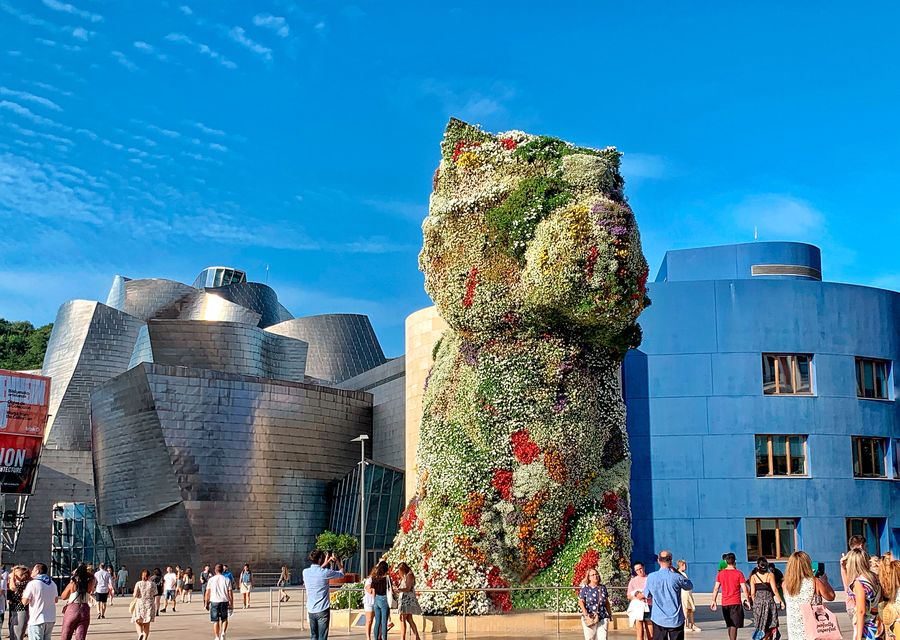
While the museum’s interior offers world-class contemporary art exhibitions, don’t miss the opportunity to explore its exterior and surroundings. Take a walk along the riverfront and admire the museum from different angles, where its reflective surfaces change with the time of day and the weather. Be sure to interact with the public art installations, such as Jeff Koons’ playful Puppy and Louise Bourgeois’ monumental spider sculpture Maman. For an unforgettable experience, visit the museum in the evening, when its undulating titanium facade is illuminated, casting a glow over the Nervión River.
Zubizuri Bridge (White Bridge)
Our final stop on the walking tour is the Zubizuri Bridge, an elegant pedestrian bridge that spans the Nervión River and connects the Old Town with the modern city center. Designed by the famous Spanish architect Santiago Calatrava, the Zubizuri (which means "white bridge" in Basque) opened in 1997, the same year as the Guggenheim Museum.
The bridge’s distinctive design, with its curved arch and translucent glass walkway, is a testament to Calatrava’s innovative architectural style. The Zubizuri Bridge is part of Bilbao’s urban renewal project, which aimed to integrate modern design into the city’s historic fabric. The bridge’s graceful form and its location near the Guggenheim Museum make it a symbol of Bilbao’s transformation into a city that values both tradition and cutting-edge design.
Walking across the Zubizuri Bridge, you’ll get stunning views of the Guggenheim Museum, the Nervión River, and the surrounding cityscape. The bridge is particularly beautiful at night when it is illuminated, casting reflections on the water below.
The Zubizuri Bridge is a symbol of Bilbao’s embrace of modern architecture and design as part of its urban regeneration. Its construction was part of a broader effort to reconnect the city with its river and create new public spaces that reflect Bilbao’s innovative spirit.
The Zubizuri Bridge is a great spot for photos, especially in the evening when the lights of the city reflect on the river. If you’re looking for a place to end your day, consider taking a leisurely walk along the riverfront, where you’ll find several bars and restaurants offering views of the Nervión.
Conclusion
Our walking tour of Bilbao has taken you through the city’s rich history, from its medieval origins in the Casco Viejo to its modern architectural masterpieces like the Guggenheim Museum and the Zubizuri Bridge. Along the way, we’ve explored Bilbao’s vibrant cultural scene, tasted its renowned Basque cuisine, and discovered how the city has transformed itself into one of Europe’s most dynamic urban destinations.
Bilbao is a city that embraces both its past and its future, where the Gothic spires of the Catedral de Santiago stand alongside the titanium curves of the Guggenheim Museum. Whether you’re drawn to its artistic heritage, its traditional Basque culture, or its cutting-edge design, Bilbao offers something for every traveler.
We hope this walking tour has given you a deeper appreciation for Bilbao’s beauty, history, and cultural significance.
To listen to more amazing audio tours of cities around the world check out our other guides at voyageowl.com