A guide, not a schedule.
Leave room to linger
Total outing time depends on the stops you choose. Original time and distance estimates are being checked.
Check your own route
Stairs, surfaces, and step-free entrances have not had a complete field audit. Check access with each venue.
Choose what interests you
Read from anywhere, or follow selected chapters in person. Entry tickets and transport are separate.
A story at every stop.
Introduction
Welcome to Voyage Owl’s walking tour of Guimarães, often referred to as the "Cradle of Portugal," a city of immense historical importance and one of the most significant places in the formation of the Portuguese nation. Located in northern Portugal, in the Minho region, Guimarães is where the country’s first king, Afonso I of Portugal (also known as Afonso Henriques), was born and where the foundations of Portugal’s independence were laid. The city is steeped in medieval charm, with its well-preserved old town, castles, palaces, and churches, all contributing to its designation as a UNESCO World Heritage Site in 2001.
Guimarães’ history stretches back to the 9th century, when it was established as a settlement around a monastery. However, its significance grew in the 12th century, when it became a pivotal point in the conflict between the Kingdom of León and the emerging Kingdom of Portugal. The Battle of São Mamede in 1128, fought near the city, was a decisive moment that paved the way for Portuguese independence. Following this victory, Afonso Henriques declared himself Prince of Portugal, and within a few decades, Portugal was recognized as a sovereign kingdom, with Guimarães at the heart of this nation-building process.
Today, Guimarães is a city where the medieval past lives alongside a vibrant modern culture. Its narrow cobblestone streets, ancient castles, and beautifully restored buildings transport visitors back to the Middle Ages. Yet, Guimarães is also home to a thriving university, contemporary art centers, and a lively cultural scene, which earned it the title of European Capital of Culture in 2012. From its towering castle to its quaint squares and historic monasteries, Guimarães offers a journey through the rich history of Portugal while embracing modernity with elegance and creativity.
This walking tour will guide you through the most iconic landmarks of Guimarães, uncovering the city’s deep historical roots and exploring its unique blend of medieval and modern influences. From the birthplace of the Portuguese nation to its vibrant cultural hubs, this tour will provide a deeper understanding of why Guimarães is truly the cradle of Portugal.
Castelo de Guimarães (Guimarães Castle)
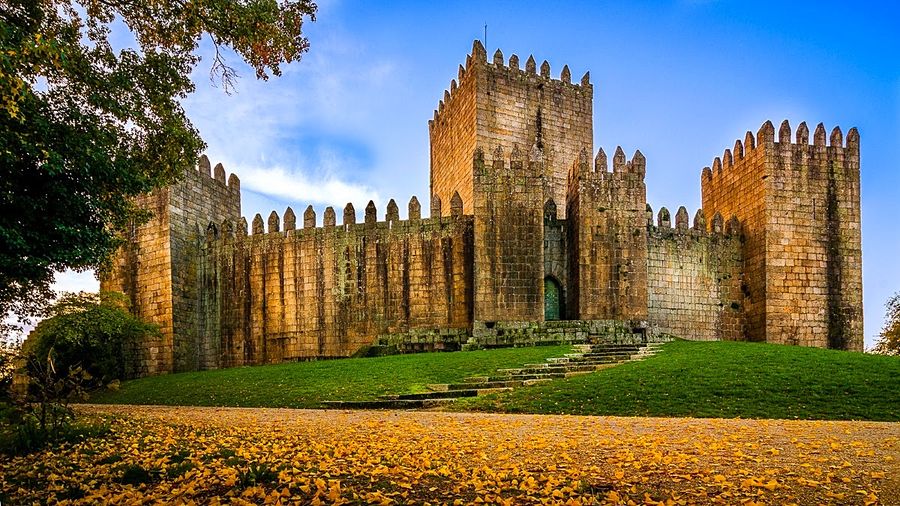
We begin our journey through Guimarães at its most iconic and historically significant monument, the Castelo de Guimarães. This ancient fortress is more than just a beautiful relic of Portugal's medieval past; it’s a cornerstone of the nation’s identity and is deeply tied to the country’s foundation.
The castle’s origins date back to the 10th century, when the region was still a part of the Kingdom of León. At the time, Countess Mumadona Dias, a powerful noblewoman, ordered the construction of a monastery to promote Christianity in the region. However, with the Iberian Peninsula under constant threat from both Moorish and Norse (Viking) invasions, she recognized the need for protection. To defend the monastery and its surrounding inhabitants, Countess Mumadona erected a military tower—the foundation of what would later become the Guimarães Castle.
Over the next few centuries, the defensive tower was expanded and fortified. By the 12th century, under the rule of Count Henry of Burgundy and his son Afonso Henriques, the tower evolved into a full-scale castle, complete with thick granite walls, crenellated towers, and a central keep. The castle’s location on a hill provided strategic defense advantages, offering a commanding view of the surrounding land. Its architectural features, including the merlons (the gaps in the battlements used for archers) and slit windows, are classic examples of medieval fortifications designed for both defense and surveillance.
Guimarães Castle holds a special place in Portuguese history because it is closely tied to the birth of the nation. It is here, in the shadow of its stone walls, that Afonso Henriques, Portugal’s first king, was born around 1109. His mother, Teresa of León, ruled the County of Portugal (then a vassal of the Kingdom of León), and young Afonso was raised in the region. As a young man, he famously rebelled against his mother’s allegiance to León, seeking to carve out an independent path for his homeland.
The defining moment came with the Battle of São Mamede in 1128, fought just outside the city of Guimarães. Afonso Henriques, leading a group of Portuguese nobles and knights, emerged victorious against the forces loyal to his mother and her Leónese allies. This victory marked the beginning of Portugal’s path toward full independence, and it earned Guimarães the title of the “Cradle of Portugal.”
The castle itself played a key role in these early conflicts, serving as a military stronghold during Afonso’s campaigns to consolidate his power and defend his territory from both internal and external threats.
As you approach the castle, the grandeur of its towering stone walls becomes evident. The central keep, standing at the heart of the castle, is the most imposing structure and served as the last line of defense during sieges. From here, the defenders could rain arrows or boiling oil down on attackers. The castle’s walls are dotted with battlements that offer spectacular views over Guimarães and the surrounding Minho countryside.
Inside the castle, you’ll find a simple but evocative space. Unlike more elaborate medieval castles, Guimarães Castle reflects its original purpose as a defensive fortress rather than a royal residence. It’s easy to imagine soldiers standing guard along the walls or preparing for battle within the central courtyard.
Today, the castle is not just a place to learn about military history but also a symbol of national pride. The Portuguese flag flies high above the battlements, a reminder of the role this site played in the birth of the country. Informational plaques and exhibits detail the castle’s history, including its role in the Reconquista, as well as its restoration in the 20th century to preserve it for future generations.
The Castelo de Guimarães is more than just a medieval relic; it’s a potent symbol of Portugal’s identity as an independent nation. Its connection to Afonso Henriques and the Battle of São Mamede makes it one of the most historically significant monuments in the country. The castle’s strategic role during the Reconquista, when Christian forces sought to reclaim land from the Moors, adds further depth to its story, as it reflects the turbulent centuries of war and conflict that shaped the Iberian Peninsula.
Be sure to take your time exploring the castle’s walls and climbing the central keep for panoramic views of Guimarães. On a clear day, you can see the city’s historic center and the lush, green hills of the Minho region. Visiting early in the morning or late in the afternoon is recommended, as the soft light casts dramatic shadows over the fortress, heightening its medieval atmosphere.
Paço dos Duques de Bragança (Ducal Palace of the Bragança Family)
Just a short walk from Guimarães Castle is the Paço dos Duques de Bragança, a grand 15th-century palace that reflects the rising power and influence of the House of Bragança, one of Portugal’s most important noble families. The palace, built in 1401 by Dom Afonso, Duke of Bragança, was designed not only as a residence but as a symbol of the family’s wealth and status in Portuguese society.
The Ducal Palace is an impressive blend of medieval, Gothic, and Renaissance architectural styles, and its design was heavily influenced by the French castles and palaces that Dom Afonso encountered during his time abroad. The building’s exterior is dominated by thick stone walls, massive chimneys, and round arched windows, giving it the appearance of both a fortress and a noble residence. The chimneys, in particular, are a defining feature of the palace’s silhouette and are visible from much of the city.
As you enter the palace, you’ll immediately be struck by its grand scale and elegance. The central courtyard, surrounded by arcaded galleries, is a beautiful example of the Gothic style, with its pointed arches and delicate stonework. This space would have been the heart of the palace’s daily life, where noble families and their retinues gathered for meals, celebrations, and important meetings.
One of the most remarkable aspects of the palace is its banquet hall, a vast space with a spectacular wooden ceiling that resembles the hull of a ship. This unique design is a tribute to Portugal’s maritime heritage and reflects the era’s deep connection to the sea, as the country was entering its golden age of exploration. The hall was used for lavish feasts and important state functions, and its grandeur is a testament to the power of the Bragança family.
The Paço dos Duques de Bragança was built during a time of great political and social change in Portugal. Dom Afonso, Duke of Bragança, was an illegitimate son of King João I and a powerful noble who wielded immense influence at the royal court. His marriage to Constança de Noronha, a descendant of Portuguese royalty, further solidified his family’s status. The palace reflects the growing power of the House of Bragança, which would eventually become the ruling dynasty of Portugal in 1640.
The Bragança family played a crucial role in Portugal’s history, especially after the Portuguese Restoration War, when the country regained its independence from Spain. In 1640, Dom João IV, a member of the Bragança family, was crowned King of Portugal, marking the beginning of the Bragança dynasty, which ruled the country for over two centuries.
Inside the palace, you’ll find a museum that houses a remarkable collection of furniture, tapestries, ceramics, weapons, and art from the 15th to 19th centuries. Each room is decorated to reflect the opulence of the era, with luxurious textiles, intricate tapestries, and finely crafted furniture that once belonged to the Bragança family. The palace is designed to give visitors a sense of what life was like for the nobility during Portugal’s golden age.
One of the highlights of the palace is the private chapel, dedicated to Saint Francis of Assisi. The chapel’s stained glass windows, gilded altarpieces, and religious paintings make it a peaceful and reflective space. The banquet hall is another must-see, with its grand wooden ceiling and impressive scale. This hall is where the Bragança family hosted royal banquets, political meetings, and celebrations, and it remains one of the most awe-inspiring rooms in the palace.
The Paço dos Duques de Bragança is not only a beautiful architectural masterpiece but also a symbol of the political and social power of the Bragança family, who would go on to rule Portugal during some of its most important historical periods. The palace reflects the grandeur of the noble class during the 15th century and offers insights into the lives of the aristocracy who played a key role in shaping the destiny of Portugal.
Make sure to explore all the rooms in the palace, as each one offers a different aspect of the Bragança family’s life and Portugal’s noble history. The banquet hall is particularly photogenic, so bring your camera to capture the grandeur of the wooden ceiling and massive chimneys. The courtyard is also a lovely spot to sit and soak in the history while enjoying views of the surrounding castle and city.
Largo da Oliveira and Igreja de Nossa Senhora da Oliveira
From the Ducal Palace, we head down to the heart of Guimarães’ medieval old town, arriving at the charming Largo da Oliveira. This picturesque square is one of the most beautiful and historic parts of the city, surrounded by medieval buildings and shaded by ancient olive trees. The square is named after the Igreja de Nossa Senhora da Oliveira (Church of Our Lady of the Olive Tree), one of the oldest and most important churches in Guimarães.
The Igreja de Nossa Senhora da Oliveira was originally founded in the 10th century, but it was rebuilt in the 14th century by King João I to commemorate his victory at the Battle of Aljubarrota in 1385, which secured Portugal’s independence from Castile. The church is a stunning example of Gothic architecture, with its ornate stone carvings, rose windows, and soaring bell tower. Inside, you’ll find a beautifully decorated Baroque altarpiece, as well as the tomb of Dom João de Meneses, a knight who fought in the battle.
In front of the church stands the Padrão do Salado, a Gothic shrine built to celebrate the Battle of Salado in 1340, where Portuguese and Castilian forces defeated the Moors. The shrine, with its pointed arches and intricate stonework, adds to the medieval atmosphere of the square.
Largo da Oliveira is also home to several cafés and restaurants, making it a popular spot for locals and visitors to relax and enjoy the historic surroundings.
The Igreja de Nossa Senhora da Oliveira and the Padrão do Salado are both symbols of Portugal’s struggle for independence and its military victories over Castile and the Moors. The square itself has been a central part of life in Guimarães for centuries, and its medieval buildings reflect the city’s rich history.
Enjoy a coffee or glass of wine at one of the cafés in Largo da Oliveira while taking in the medieval surroundings. Be sure to visit the interior of the church, where you can see the intricate Baroque altarpiece and admire the stained glass windows.
Museu de Alberto Sampaio (Alberto Sampaio Museum)
Next, we visit the Museu de Alberto Sampaio, located just off Largo da Oliveira in the former Monastery of Nossa Senhora da Oliveira. This museum is one of the best places in Guimarães to learn about the city’s religious and artistic heritage, with a vast collection of sacred art, sculptures, textiles, and religious objects.
The museum is named after Alberto Sampaio, a historian and writer who played a key role in preserving Portugal’s cultural heritage. The collection includes stunning pieces of liturgical clothing, medieval paintings, sculptures, and goldwork, many of which were originally housed in the churches and monasteries of Guimarães. One of the museum’s most famous pieces is the tunicle worn by King João I at the Battle of Aljubarrota, a fascinating relic from Portugal’s medieval past.
The cloisters of the Monastery of Nossa Senhora da Oliveira, which are part of the museum, offer a peaceful and atmospheric space to explore. The intricate stone arches and ancient columns give you a sense of the monastic life that once thrived in Guimarães.
The Museu de Alberto Sampaio houses some of the most important religious artifacts and art from Guimarães and the surrounding region. It offers valuable insights into the city’s religious history and its role in Portugal’s cultural and spiritual life.
The museum is a quiet and contemplative space, perfect for those interested in art and history. Don’t miss the cloisters, which are one of the most serene spots in the city.
Igreja de São Francisco (Church of Saint Francis)
Our next stop takes us to the Igreja de São Francisco, a beautiful Baroque church located just a short walk from the Cidade Velha. The Igreja de São Francisco was founded in the 13th century by the Franciscan Order, but much of what you see today dates from the 18th century, when the church was rebuilt in the ornate Baroque style.
The exterior of the church is relatively simple, but the interior is a masterpiece of Baroque art, with gilded wood carvings, intricate azulejos (Portuguese tiles), and a grand altarpiece that features scenes from the life of Saint Francis of Assisi. The ceiling of the church is particularly impressive, with beautifully painted panels depicting biblical stories and saints. The chapels inside the church are also adorned with gilded altars and religious sculptures, making it one of the most richly decorated churches in Guimarães.
The Igreja de São Francisco is still an active place of worship, and it plays an important role in the religious life of the city. It’s also a popular site for visitors who want to experience the grandeur of Baroque religious architecture in Portugal.
The Igreja de São Francisco reflects the influence of the Franciscan Order in Guimarães and the city’s religious importance during the Middle Ages and Baroque period. The church’s opulent interior is a testament to the artistic and architectural creativity of the 18th century.
If you’re a fan of Baroque art, the Igreja de São Francisco is a must-see. Take your time to explore the interior, particularly the ceiling and the gilded altarpieces. The church is also a peaceful spot to sit and reflect.
Teleférico de Guimarães (Guimarães Cable Car) and Monte da Penha
For a change of pace and some of the best views in the region, we head to the Teleférico de Guimarães, a cable car that takes you up to the top of Monte da Penha, a hill located just outside the city. The cable car ride offers stunning panoramic views of Guimarães and the surrounding countryside, and it’s a great way to get a sense of the city’s layout and its place in the wider Minho region.
At the top of Monte da Penha, you’ll find the Santuário da Penha, a modern sanctuary dedicated to Our Lady of the Rock. The sanctuary is surrounded by beautiful gardens, woodlands, and rock formations, making it a perfect spot for hiking and picnicking. There are several walking trails that wind through the hilltop, offering peaceful and scenic views.
Monte da Penha is also a popular pilgrimage site, especially during the annual festival in September, when thousands of people from across the region come to the sanctuary to celebrate.
The Santuário da Penha and Monte da Penha have long been associated with religious devotion in Guimarães. The sanctuary is a key pilgrimage site, and the hilltop has been a place of spiritual reflection for centuries.
The Teleférico de Guimarães is a fun and relaxing way to see the city from above. Once at the top, take a hike through the Monte da Penha trails, or simply relax in the peaceful surroundings. Be sure to bring your camera for the incredible views!
Conclusion
Our walking tour of Guimarães has taken you through centuries of Portuguese history, from its medieval roots as the birthplace of the nation to its vibrant cultural life today. We’ve explored iconic landmarks such as the Castelo de Guimarães, the Paço dos Duques de Bragança, and the charming squares of the Cidade Velha, while also delving into the city’s religious and artistic heritage.
Guimarães is a city where the past is very much alive, and its beautifully preserved medieval architecture and rich cultural history make it one of the most important historical cities in Portugal. Whether you’re captivated by its medieval castles, its grand palaces, or its picturesque streets, Guimarães offers a unique glimpse into the heart of Portuguese history and culture.
We hope this walking tour has given you a deeper appreciation for Guimarães’s beauty, history, and significance as the “Cradle of Portugal.” Boa viagem! Enjoy the rest of your time exploring this remarkable city!
To listen to more amazing audio tours of cities around the world check out our other guides at voyageowl.com